-
 play_arrow
PUKfm
-
 play_arrow
London Calling Podcast Yana Bolder
-
 play_arrow
Summer Festival Podcast Robot Heart
-
 play_arrow
Electronic Trends Podcast Aaron Mills
-
 play_arrow
New Year Eve Podcast Robot Heart
-
 play_arrow
Techno Podcast Robot Heart
-
 play_arrow
Flower Power Festival Podcast Robot Heart
-
 play_arrow
Tech House Podcast Robot Heart
-
 play_arrow
Winter Festival Podcast Robot Heart
music_note


THE HISTORY OF THE CHRISTMAS TREE

Simoné de Witt & James Klusener
@simone_de_witt & @jamesklusener
Christmas trees are a familiar marker that the festive season has arrived. They are decorated and displayed in homes across the world, yet few people stop to ask why this tradition exists. Why do we cut down trees, or buy artificial replicas, and bring them indoors for a few weeks each year? Here is a brief history of the Christmas tree and where the tradition truly began.
Pagan Roots Before Christianity
While Christmas trees are often associated with Christianity, their origins predate the religion. Long before the birth of Christ, ancient pagan cultures across Europe used evergreen plants during winter festivals. Evergreens were valued because they remained green during the cold, dark months and symbolised life, renewal and hope.
In particular, ancient Germanic and Nordic peoples brought evergreen branches into their homes during the winter solstice to celebrate the return of the sun and the promise of spring. These practices laid the symbolic foundation for what would later become the Christmas tree.
The First Christmas Trees in Germany
The Christmas tree as we recognise it today emerged in 16th-century Germany. Historical records indicate that Christian families began bringing entire evergreen trees into their homes and decorating them with items such as apples, nuts and candles. One of the earliest written references describes a decorated tree in what is now modern-day Germany.
The use of evergreen trees came to represent eternal life, renewal and the triumph of life over death — symbolism that aligned naturally with Christian beliefs about Christ’s birth.
From Religious Tradition to Popular Custom
By the 18th and early 19th centuries, Christmas trees were still largely viewed as a niche German custom. This changed dramatically in Victorian Britain.
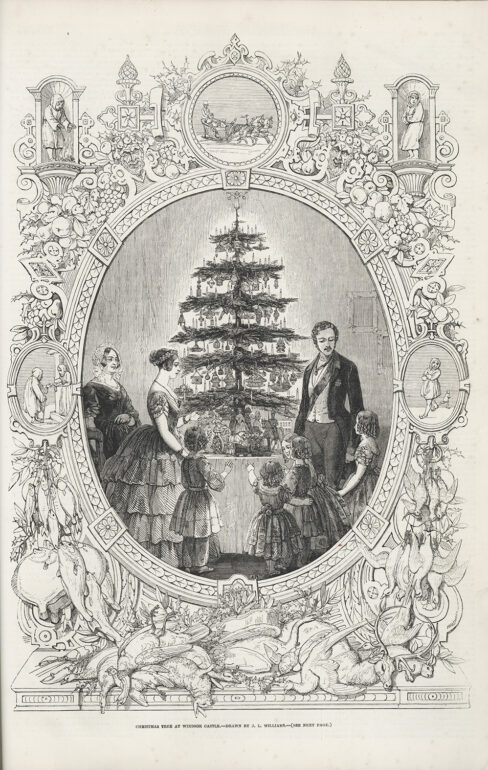
In 1848, an illustration published in The Illustrated London News showed Queen Victoria and Prince Albert, who was German, standing with their children around a decorated Christmas tree at Windsor Castle. The image captured the public’s imagination and rapidly popularised the tradition across Britain and beyond:
The Christmas Tree Reaches America
The trend soon spread to the United States, particularly among German immigrant communities on the East Coast. In 1853, President Franklin Pierce introduced the first documented Christmas tree in the White House, helping to cement the tradition in American culture.
By the late 19th century, Christmas trees had become a widespread feature of festive celebrations in Europe and North America.
Lights, Landmarks and Modern Traditions
With the advent of electricity, Christmas tree decorations evolved further. Electric Christmas lights began appearing deter trees in the early 20th century, replacing candles and making displays safer and more elaborate.
In 1931, workers at Rockefeller Center in New York erected the first Rockefeller Center Christmas tree. Initially modest in size and decoration, the tree grew into a global symbol of Christmas when permanent lighting was added in 1933.
Christmas Trees Today
Today, Christmas trees are embraced by both religious and secular households. Whether natural or artificial, they remain central to festive celebrations. It is estimated that around 100–120 million natural Christmas trees are cut down worldwide each year. Despite this, many are farmed sustainably, and artificial trees have become an increasingly popular alternative.
From ancient pagan symbolism to modern festive centrepieces, the Christmas tree’s journey reflects centuries of cultural evolution — proving that some traditions endure because they continue to bring people together.

Edited by Simoné de Witt


Chart
-
-
-
 play_arrow
I Had Some Help (feat. Morgan Wallen) Post Malone
-
-
-
 play_arrow
Not Like Us Kendrick Lamar
-
-
Top popular

VARSITY CUP TICKET RESELLERS AND BUYERS – MAY BE DENIED ACCESS

UNANSWERED AND UNSPOKEN: NWU’S SILENCE ON SUSPENSION OF SCC STUDENT LEADER

NWU EXPELS STUDENT LEADER AFTER INTERNAL FINDING OF SEXUAL MISCONDUCT

MARCHING FOR JUSTICE AND POLICE ACCOUNTABILITY: THE TRUTH BEHIND THE TMM LOFTS PROTEST

DEGENAAR PRAAT OOR DIE NA-SKOK VAN ‘N TRAGEDIE

Post comments (0)