-
 play_arrow
PUKfm
-
 play_arrow
London Calling Podcast Yana Bolder
-
 play_arrow
Summer Festival Podcast Robot Heart
-
 play_arrow
Electronic Trends Podcast Aaron Mills
-
 play_arrow
New Year Eve Podcast Robot Heart
-
 play_arrow
Techno Podcast Robot Heart
-
 play_arrow
Flower Power Festival Podcast Robot Heart
-
 play_arrow
Tech House Podcast Robot Heart
-
 play_arrow
Winter Festival Podcast Robot Heart
music_note

NWU’S DR WILLIAMS WINS M&G AWARD
Christabell Lourens
@_clourens_
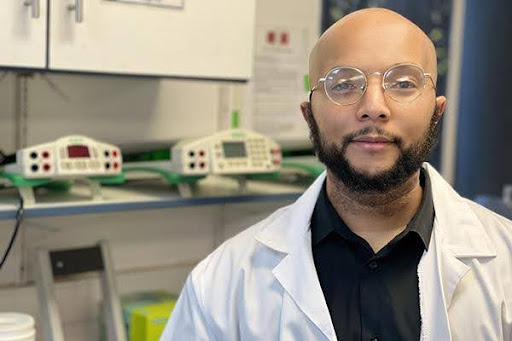
Dr Monray Williams, a biochemistry lecturer and researcher at the North-West University, joined Dr Odendaal on the Mail and Guardian’s (M&G) 200 Young South Africans award stage.
(See https://pukfm.com/2024/07/29/from-the-classroom-to-the-mg-award-stage/ for Dr Odendaal’s feature.)
The M&G Award is a highly esteemed prize awarded each year. Obtaining the award is definitely not a walk in the park. Per the official Mail and Guardian page, candidates must be nominated by the public before being assessed by judges. The judges select winners based on their “exceptional talent, innovation, and leadership” in their respective fields.
Dr Williams has been designated as the Science, Technology and Innovation winner. This is largely in recognition of Dr Williams’ contributions to the field of Human Immunodeficiency Virus-1 (HIV-1) research. In addition to his research, he continues to hold down his post as a senior lecturer in biochemistry at the NWU.
Wapad sat down with Dr Williams to learn more about his experience as a lecturer and talented scientist. “I didn’t really know what I wanted to study after school, which I think is quite common. I was interested in sport science until my mother told me ‘I think you look like you’d work in a lab,’” Dr Williams explained.
As a result of his mother’s encouragement, Dr Williams started his Bachelor of Science in Biotechnology at the University of the Western Cape (UWC). His passion for the subject was ignited during his undergraduate years, as he saw the potential for biotechnology to solve real-world problems.
Afterwards, when he completed his master’s degree, Dr Williams had successfully created a point-of-care device capable of detecting HIV-1 better than any kits on the market at the time. This success saw him pursue his HIV-1 research further into his Doctor of Philosophy (PhD), which focused on how the virus affects the brain.
“At the stage of master’s, I knew I wanted to stay in academia and that this was my dream job,” he mentioned.
While he admited that his master’s went quite smoothly, he also acknowledged that his PhD brought about new challenges: “The PhD was the hardest. People think that for a PhD you only need to be book smart, but there are a lot of new things that come into play, like resilience – when all is failing, to know that there is an end in sight. You need to have a certain level of inherent motivation to get through it.”
After completing his PhD, Dr Williams was offered a position at the NWU as a lecturer. Since his arrival in 2020, he has not only made an imprint on his students but has also managed to win the Novice Teaching Award in 2022. He stated that while teaching and researching can be hard to balance, it is by no means impossible.
“In science, we tend to consider ourselves subject matter experts and not educational experts. I’ve always had this thought of joining the world of academia and teaching. The way I see it is that if I improve the quality of today’s students, they will in turn publish better research at a postgraduate level,” he said.
Dr Williams added that he has a motto regarding this, “The difference between extraordinary and ordinary is just a little bit extra.” He hopes to impart this to his students by keeping them engaged and interested in the field of biochemistry.
Dr Williams affirmed that – contrary to the opinions of some – scientists do have it in them to be good teachers, “As a scientist, you need to become a well-rounded academic. You need to be able to share your knowledge with the next generation.”
He also added that a major misconception about the field of science is that South African scientists cannot be competitive globally. “I think that particular ideology should change. Research is a long-term career, and you only see the dividends later on, but more and more we are seeing younger scientists that are already making significant waves. This shows that we have what it takes to be global leaders in our fields,” he explained.
He went on to name a few scientists and academics who have greatly influenced his work, such as the University of Pretoria’s Professor Thulani Makhalanyane. He also names his father as one of the great motivators of his career. Dr Williams believes that if someone else can do it, so can he. As a result, he keeps up to date with his fellow academics and analyses the success of others to gain a better understanding of their processes.
Dr Williams received his BSc and master’s degree from UWC but was accepted for his PhD by the University of Cape Town (UCT). He recommended that young academics explore other institutions to expand their knowledge and experience in their fields, “Making that move from UWC to UCT gave me a new perspective on many things and gave me a whole new set of skills. Moving to Potchefstroom, which is primarily a student town, was culturally so different, but I could manage it because I had moved around before.”
Even with all of his past experience across institutions, Dr Williams mentioned that the NWU has been a very positive experience for him. “In terms of work, I always want to remain competitive,” said Dr Williams. “My work environment is so great here and there’s still many things I want to achieve. I consider this an upward trajectory for my career. I can’t even say one bad thing about my work environment,” he added.
As a lecturer, however, Dr Williams affirmed that he has seen some concerning trends develop among his students: “I’m really concerned about this idea of ‘I don’t need to learn, I just need to pass’. My biggest fear is what type of student this mindset is producing, especially for the future of academia. Sometimes students feel entitled to a pass and only do the bare minimum.”
Dr Williams said that another worrisome trend is the lack of funding. He stated that funding is a major motivator for further study and that things like budget cuts negatively affect the scientific world. As a result, some of the larger academic institutes dominate the playing field in South Africa, which in turn results in less international funding for intuitions that are not a part of “the big boys”.
Despite these factors, Dr Williams’ hope for the future of biotechnology and neuroscience is bright: “I hope for a space where we are given an equal place abroad and that those opportunities are also afforded to South African scientists. I think we have to work a lot harder to get the same funding and my wish is that this won’t be the same in the future.”
Dr Williams emphasised the importance of elevating our country to a level where we produce scientists on our own, as opposed to sending them abroad for further training.
Dr Williams’ message to young academics is clear, “To have passion for what you do and believe that you can do it.” He stated that his only regret thus far is not realising that this is what he wanted to do with his life sooner, “We need more bright people who want to change the landscape of South Africa. No scientist doesn’t want to leave a legacy, and we have the potential to make that impact.”
Edited by Jomari Langenhoven
Similar posts

Chart
-
-
-
 play_arrow
I Had Some Help (feat. Morgan Wallen) Post Malone
-
-
-
 play_arrow
Not Like Us Kendrick Lamar
-
-
Top popular

VARSITY CUP TICKET RESELLERS AND BUYERS – MAY BE DENIED ACCESS
UNANSWERED AND UNSPOKEN: NWU’S SILENCE ON SUSPENSION OF SCC STUDENT LEADER

NWU EXPELS STUDENT LEADER AFTER INTERNAL FINDING OF SEXUAL MISCONDUCT

MARCHING FOR JUSTICE AND POLICE ACCOUNTABILITY: THE TRUTH BEHIND THE TMM LOFTS PROTEST
DEGENAAR PRAAT OOR DIE NA-SKOK VAN ‘N TRAGEDIE

Post comments (0)