-
 play_arrow
PUKfm
-
 play_arrow
London Calling Podcast Yana Bolder
-
 play_arrow
Summer Festival Podcast Robot Heart
-
 play_arrow
Electronic Trends Podcast Aaron Mills
-
 play_arrow
New Year Eve Podcast Robot Heart
-
 play_arrow
Techno Podcast Robot Heart
-
 play_arrow
Flower Power Festival Podcast Robot Heart
-
 play_arrow
Tech House Podcast Robot Heart
-
 play_arrow
Winter Festival Podcast Robot Heart
music_note

PURPLE SOLIDARITY: STANDING AGAINST GBV AND FEMICIDE
Mhlengi Khumalo
@into.mbiyakwakhumalo
South Africa is well known for its diverse natural beauty, from scenic mountains and coastlines to unique wildlife and famous national parks such as the Kruger National Park. It is also recognised for its vibrant, multicultural identity as the “Rainbow Nation,” its history of struggle and triumph, and its significant contributions to sports and mining. However, South Africa is also widely known for its high rates of femicide and gender-based violence (GBV), which are estimated to be four to six times higher than the global average.
South Africa is consistently ranked among the countries with the highest rates of violence against women, at times comparable to conflict zones. According to Women For Change, the country is facing one of the most severe and deadly GBV epidemics in the world. “In one year, 5 578 women were murdered — a 33.8% increase from the previous year (2024). South Africa’s femicide rate is six times higher than the global average,” the organisation stated in an Instagram post.
According to the Parliament of South Africa, femicide is generally defined as the intentional killing of women because they are women. It is most often committed by men (partners or former partners), though female family members may sometimes be involved. Femicide can also involve prolonged domestic abuse, threats or intimidation, sexual violence, or situations where women have less power or fewer resources than their partners. Parliamentary statistics indicate that the Eastern Cape has the highest rate of women over the age of 18 who have experienced gender-based violence (31.6%), while the North West has the highest rate of women over the age of 18 who have experienced sexual violence (11.8%).
South Africa is grappling with a severe epidemic of GBV and femicide, with official data confirming the daily danger many women face. This ongoing violence has created a climate of fear, leaving women feeling unsafe even within their own communities. As a result, the public is increasingly demanding clarity on what effective and urgent actions the government is taking to address this crisis. Although measures such as the National Strategic Plan and new legislation are in place, critics argue that slow implementation and gaps in accountability continue to undermine progress.
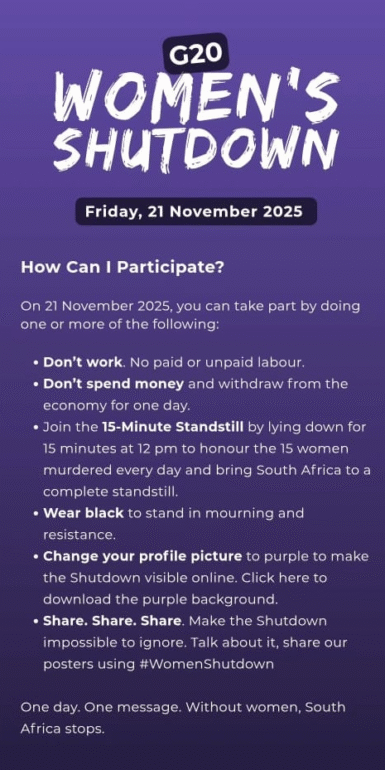
Women For Change has called for a G20 Women’s Shutdown on Friday, 21 November, stating that South African women will “silence the nation” ahead of the G20 summit. “We call on all women and members of the LGBTQI+ community across South Africa to refrain from all paid and unpaid work in workplaces, universities, homes, and communities, to demonstrate the economic and social impact of their absence. We demand that gender-based violence and femicide be declared a National Disaster. Now!”
In the Women For Change G20 Women’s Shutdown, the color purple symbolises justice, dignity, and visibility. Participants are encouraged to change their social media profile pictures to a purple background or a purple dot, making the movement impossible to ignore online. Purple is internationally recognised as a color associated with women’s rights, equality, visionary change, and commitment to social justice. Meanwhile, black clothing is encouraged during physical demonstrations, such as the 15-minute standstill, to symbolise mourning and resistance. Purple remains the central color of digital solidarity and shared purpose.
The organisation has also released participation guidelines across all platforms, accompanied by the slogan: “One day. One message. Without women, South Africa stops.”
The NGO also released an official letter for students in schools, colleges, and universities who are currently writing exams and may still want to participate in the shutdown. In the letter, they acknowledge that exams are important and that many students are unable to stay away from campus. Because of this, they have provided alternative ways for students to show their support and take part in the movement.
Here is the link to the letter:
https://womenforchange.co.za/wp-content/uploads/2025/11/Letter-to-School-University.pdf?fbclid=PAZXh0bgNhZW0CMTEAc3J0YwZhcHBfaWQPNTY3MDY3MzQzMzUyNDI3AAGnsAuv3Xeg1-EtRn29ttt-MMQ08L9QAlfsTq-mJTUU3iZg7fTSrKxR9jgItyc_aem_NcSODGHn0YulaHl35IGCuw
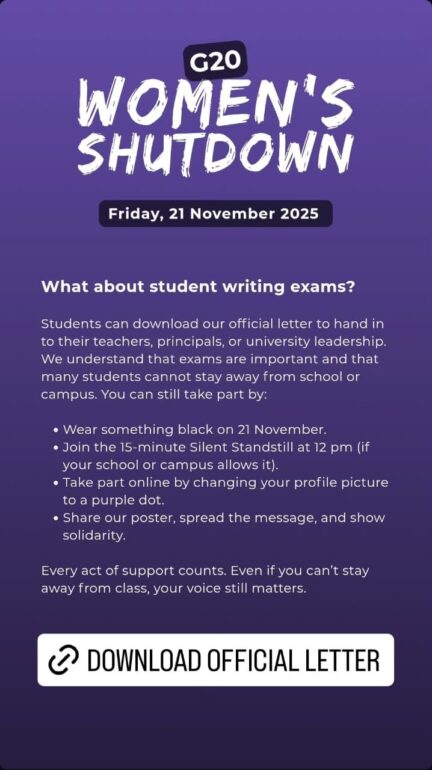
These statistics are not just numbers; they represent the mothers, sisters, and daughters lost to an epidemic that the government has been slow to stop. The G20 Women’s Shutdown on Friday, 21 November, is a direct and unified response from a society that refuses to remain silent. It is a deliberate show of purple solidarity, aiming to demand accountability and real action. The message is clear, and the country will be forced to hear it: “One day. One message. Without women, South Africa stops.”
Edited by Simoné de Witt
Similar posts

Chart
-
-
-
 play_arrow
I Had Some Help (feat. Morgan Wallen) Post Malone
-
-
-
 play_arrow
Not Like Us Kendrick Lamar
-
-
Top popular

VARSITY CUP TICKET RESELLERS AND BUYERS – MAY BE DENIED ACCESS

UNANSWERED AND UNSPOKEN: NWU’S SILENCE ON SUSPENSION OF SCC STUDENT LEADER

NWU EXPELS STUDENT LEADER AFTER INTERNAL FINDING OF SEXUAL MISCONDUCT

MARCHING FOR JUSTICE AND POLICE ACCOUNTABILITY: THE TRUTH BEHIND THE TMM LOFTS PROTEST

DEGENAAR PRAAT OOR DIE NA-SKOK VAN ‘N TRAGEDIE

Post comments (0)